Category: Walking tours


<<<<<<< HEAD =======

>>>>>>> d45f4aebe31e08c5f8618e664b1d5380a0bbc3b1

By Caro,

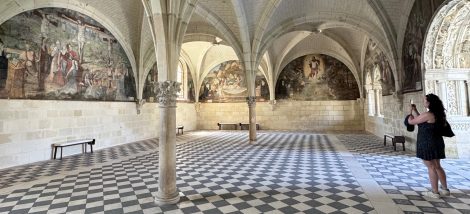
Fontevraud Abbey where Eleanor of Aquitaine spend her final years and was buried

Celebrating Three Lessons from Queen Eleanor of Aquitaine

Eleanor of Aquitaine: queen twice over, rebel, crusader, and one of the most extraordinary women who ever lived.

Lesson 1 – Be Bold

Despite living in an era where women had little power even when born into a mighty inheritance as she was, she cultivated boldness. She was considered indiscreet in both dress and language. In her seventies, Eleanor rode on horseback from Aquitaine to Spain to personally vet a suitor for her granddaughter. Across mountains. In her seventies. On horseback. Legend.

Lesson 2 – Always have the last word

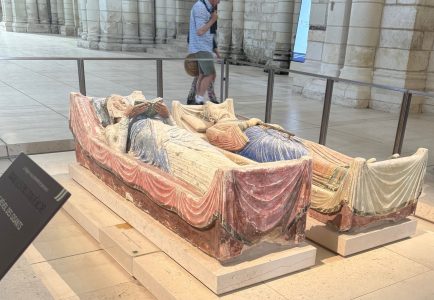
Eleanor had her effigy – a painted stone sculpture over her burial crypt – made larger and higher than the one for her philandering husband Henry that is next to her. It can be visited at Fontevraud Abbey in the Loire Valley where she was entombed between Richard I the Lionheart, her son, and Henry.
Lesson 3 – Culture and education are important

The effigy of the Queen is wearing a crown and has an open book in her hands. Some speculate that its a Bible but others think that it is a poetry book. Eleanor was a supporter of the arts and of the troubadours.

The History of Eleanor

The Girl Who Married the French King at 15 and the English King at 28

Eleanor was born around 1124 and inherited the vast Duchy of Aquitaine as a teenager. At 15, she married King Louis VII of France in Bordeaux — a fabulous city to explore on foot  – email us for suggestions – we dont offer walking tours in Bordeaux city but we do offer walking tours in the Bordeaux Bergerac Vineyards. Keep an eye out for the bronze commemorative plate to her wedding on one of the city gates — it’s a hidden gem.

Eleanor had two daughters with Louis, accompanied him on a Crusade to the Holy Land, and while there — according to the gossip — took a lover in the afternoon. On returning from the Crusade, Eleanor decided that her husband, a man who prayed more than he ruled wasn’t what she’d signed up for. She persuaded the Pope to annul their marriage on grounds of consanguinity (distant family connection). Louis was also under pressure to move on as Eleanor hadn’t produced a male heir so it wasn’t completely one sided.

Next she married a Toyboy Who Became King of England

Within just two months of her annulment, Eleanor married Henry Plantagenet, who was several years her junior. He went on to become King Henry II of England — which meant that Aquitaine, her beloved home duchy, came under English rule. As a wealthy single woman in the 12th century, remarrying quickly wasn’t just a romantic choice — it was a matter of survival. Single noblewomen were prime targets for abduction and forced marriage. Eleanor moved fast and married smart.

The Wine Deal That We Love

Eleanor and Henry granted the town of Saint-Émilion its city rights. In return? Fifty barrels of their finest wine per year. The English Rule – 1152 to 1453 – meant that for 300 years Bordeaux had the advantage with trade to England (and onward to England’s trading partners). This near-monopoly gave Bordeaux a head start part of why Bordeaux is still the most famous wine region in the world.

A supporter of the Arts

Eleanor is often celebrated for her political cunning and her influence on the arts — she was a passionate patron of the troubadours and courtly poetry. Eleanor outlived eight of her ten children, including her most famous son, Richard the Lionheart. She spent her final years at the Abbey of Fontevraud, where she died in 1204 at around 80 years old — a remarkable age for any era. Her effigy at Fontevraud Abbey is a wonderful last word: it larger and positioned higher than that of her husband Henry.
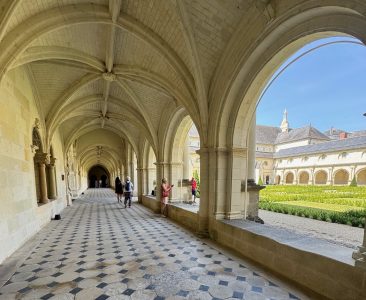
Fontevraud Abbey in the Loire Valley

The effigy shows her wearing a crown and holding an open book — believed by some to be a Bible, by others to be a poetry collection. Either way, it speaks to a woman who valued knowledge and culture. That said, despite being Queen of England for decades, she never bothered to learn English.

Visit Eleanor’s World with French Wine Adventures or on a stay at Château Feely

On our wine tours and walking tours from Château Feely, you’ll discover the living history of Nouvelle-Aquitaine — the landscape, the wines, and the remarkable stories woven into it.

If you are staying at Chateau Feely and self guiding rather than booking a tour with us – just over an hour’s drive from Chateau Feely, you can visit Richard the Lionheart’s castle at Beynac in the Dordogne. We love pairing this with a stop at Château Milandes — the former home of another iconic woman of this region, the incomparable Josephine Baker.

Two queens of different centuries. One extraordinary corner of France.

🍷 Come and discover Aquitaine’s history — and wines — with us.Email us to book your tour.

<<<<<<< HEAD =======

>>>>>>> d45f4aebe31e08c5f8618e664b1d5380a0bbc3b1

By Caro,

What is a Vineyard Walking Tour?

Let’s be honest — when someone says ‘vineyard walking tour’, you’re thinking…  am I about to suffer?

Not on French Wine Adventures!

  • We walk – but we take our time and dont overdo it –  around 10km a day. If you would like more walking there are many circular routes near the accommodation that offer delightful extra nuggets.
  • We walk – but we take the time to enjoy a long lunch with excellent food and wine.
  • We walk – but we take the time to wine taste at a vineyard /winery along the way.

🙂

Is this about fun or fitness test? 

We are delighted to say it is absolutely about fun but you will also get a good stretch of the legs. Food and wine taste so much better after a couple of hours of walking in magnificent vineyard landscapes.

French Wine Adventures walking tours can be adjusted to suit you – we can adjust to guests based on levels of fitness – they are small group tours so customisation is possible. However, they are not suitable for guests that have difficulty walking – for this we also offer classic wine tours with limited walking.

We have categorised the French Wine Adventures walking tours using the system below.

Easy: fine for occasional walkers – for example the Wine Adventure Day  or the St Emilion Grand Cru Tour

  • Average walk distance: 2 to 5 kms
  • Average walking time: Up to 2 hours

Moderate: for those who walk on a regular basis – for example the Monbazillac Walking Tour with Michelin Star restaurant lunch or one of the circuits on our Casual Walking Tour in South West France

  • Average walk distance: 6 to 10kms
  • Average walking time: Up to 4 hours

Moderate plus: for walkers who are comfortable with ascents and descents and slightly uneven terrain – for example several of our Casual Walking Tours in South West France – we have many routes to propose departing from our HQ in Saussignac

  • Average daily distance: 8-14kms
  • Average walking time: up to 4-5 hours

We walk through the vines your wine comes from. We get up close to the soil. You hear the insider wine gossip. You understand why a Bordeaux tastes like Bordeaux, St Emilion like a St Emilion or a Saussignac like a Saussignac.

Is it hard?


View this post on Instagram


A post shared by Chateau Feely (@chateaufeely)


So on the question of ‘will I suffer?’ Honestly? Sitting in a van being driven from château to château is far more exhausting.

When you walked the vineyards, touch the soil, hear the stories… that glass isn’t just wine anymore.

If this is your kind of holiday — Come walk with us!

#WineTravel #WalkingHoliday #CouplesTravel #OrganicWine #vineyardwalk

<<<<<<< HEAD =======

>>>>>>> d45f4aebe31e08c5f8618e664b1d5380a0bbc3b1

By Caro,

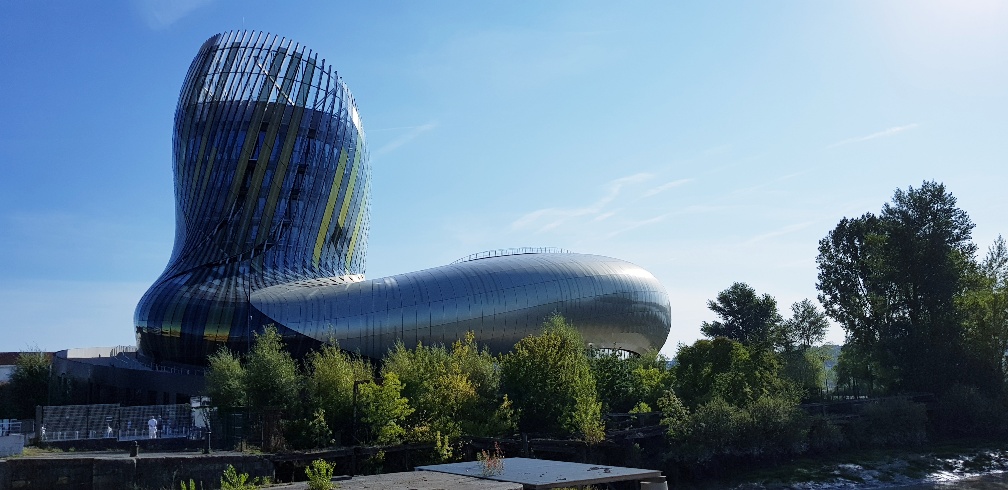
City of wine museum Bordeaux

Visiting Bordeaux and the ‘Cité du Vin’

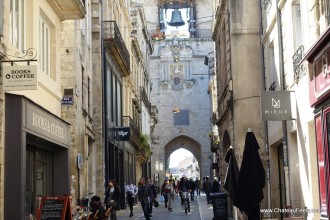
Bordeaux is a magical city. Lanes in the old town have been closed to cars. It’s picturesque and great for walking. Many of the sights are within an easy self guided walking route you can follow with a map provided by the Tourist Office. Given the size of the city itself (about 800,000 people in greater Bordeaux) and its traffic staying in Bordeaux city centre so you can walk everywhere is ideal. This post focuses on wine related places to visit on a one or two day stopover – ideal to tag onto a wine or walking tour with us in the region. Or if you are already in the area consider a one day wine tour or walking tour with us – an easy train ride from Bordeaux city.

Architecture and must sees

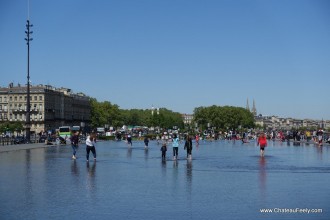
Must sees include the magnificent 18th century architecture around the place de la Bourse and the 21st century water mirror in front of it and le grand Theatre at the top end of Rue Ste Catherine. Other breathtaking historic places include la Grosse Cloche, la Porte Cailhau, many churches and cathedral St André. For shoppers Rue Ste Catherine is the longest pedestrianised shopping street in Europe and the golden triangle offers luxury brands like Louis Vuitton, Maxmara, Hermes and many more.

A winelover’s destination

The city hosts many cavistes (wine shops) including Max Bordeaux where you can buy tasting samples of top Bordeaux wines, les Tonneaux de St Jean for organic wine and an active Maison des Vins (opposite the main Bordeaux tourist office).

For winelovers les Chartrons and its wine museum (Musée du Vin et du Négoce) are worth a visit as is the magnificent new Cité du Vin Wine Museum (details below) where you can lose yourself for many hours.

All are walking distance for keen walkers or an easy hop on a tram. If you are interested in ecological developments viti the Darwin Eco-System Centre where many new urban eco projects are taking root and you can find the largest organic restaurant in France .

The Cité du Vin: the wine museum in Bordeaux

La Cité du Vin opened its doors in 2016 and already feels like a key part of Bordeaux city’s wine and tourism scene. You can buy your ticket online .

The cité du vin is a full on visual and sound experience with high tech and interactive displays.

The experience starts with an engaging 10 minute film ‘The World Wine Tour’ – a feast for the eyes flying over vineyard and winery landscapes across the globe. Then a section of wine regions of the world followed by ‘Table des Terroirs’ – winegrowers from 10 regions giving their perspective on what makes their area special. Given wine growing is about farming I found the interviews were with big names and there was little appreciation for the real winegrowers on the ground. A few infographics about the world of wine not related to selecting a display would have helped this section too.

The ‘Galerie of Civilisations’ is a superb interactive display that gives a great sense of wine history and is followed by ‘The Trend Wall’, a total contrast to the history section, offering information on latest trends in the modern world of wine.

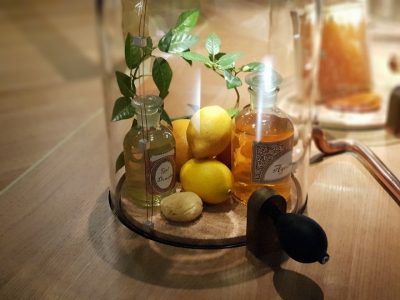
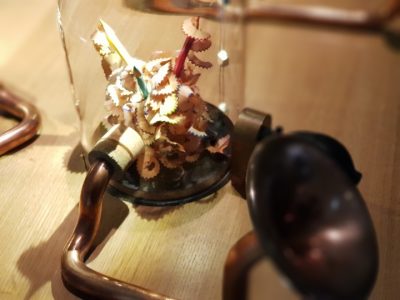
The buffet of 5 senses is mostly about aromas and visuals beautifully presented like the photo above (lemon) and below (pencil shavings). The art of living shows wine service and pairing through the ages. Wine portraits shows how different wine styles are produced and their history. There was a tucked away section that I found very interesting covering the negative effects of wine and a section in the centre about wine and love including eroticism in films, art, music, poetry and literature. I wanted to note all the films referenced in this section but by this point I was pretty exhausted having been there for 2h30 (despite skipping a fair bit). I suggest taking a break part way through for a cup of tea and a snack and then going back. Check the internet for when it is less busy too as I was there early and it wasnt too crowded but I hear it can be unpleasantly busy.

The museum experience ends with an 8 minute film ‘The Epic Tale of Bordeaux’ and you are invited to go upstairs to a tasting area to taste 1 wine from the selection available that day. There was one organic available in the large range of international and local wines. I tasted that, an estate I knew already but hadn’t tasted in years.

For me three aspects could be improved:

1. More about about organic and biodynamic viticulture and a section of real vines.

2. A fuller tasting experience.

3. Some human interaction.

I highly recommend the visit – be sure to give yourself enough time to appreciate it – at least half a day.

Conclusion

Bordeaux is a fabulous city break. Walk it to discover it well. Give yourself enough time to really appreciate the Cité du Vin. Extend your city break with a couple of days in the magnificant vineyard villages of St Emilion and Saussignac by booking onto French Wine Adventures two day wine tour or our five day wine tour or a vineyard walking tour for a full experience of the region’s natural beauty, food and wine and vineyards have to offer.