
Celebrating Three Lessons from Queen Eleanor of Aquitaine
Eleanor of Aquitaine: queen twice over, rebel, crusader, and one of the most extraordinary women who ever lived.
Lesson 1 – Be Bold
Despite living in an era where women had little power even when born into a mighty inheritance as she was, she cultivated boldness. She was considered indiscreet in both dress and language. In her seventies, Eleanor rode on horseback from Aquitaine to Spain to personally vet a suitor for her granddaughter. Across mountains. In her seventies. On horseback. Legend.
Lesson 2 – Always have the last word
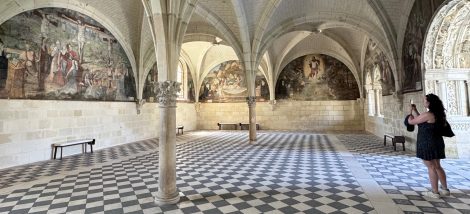
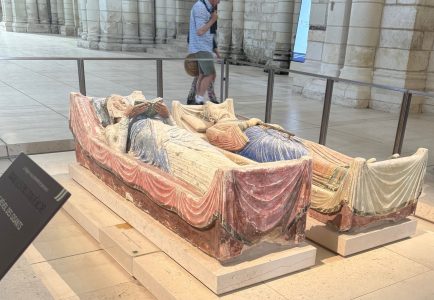
Eleanor had her effigy – a painted stone sculpture over her burial crypt – made larger and higher than the one for her philandering husband Henry that is next to her. It can be visited at Fontevraud Abbey in the Loire Valley where she was entombed between Richard I the Lionheart, her son, and Henry.
Lesson 3 – Culture and education are important
The effigy of the Queen is wearing a crown and has an open book in her hands. Some speculate that its a Bible but others think that it is a poetry book. Eleanor was a supporter of the arts and of the troubadours.
The History of Eleanor
The Girl Who Married the French King at 15 and the English King at 28
Eleanor was born around 1124 and inherited the vast Duchy of Aquitaine as a teenager. At 15, she married King Louis VII of France in Bordeaux — a fabulous city to explore on foot – email us for suggestions – we dont offer walking tours in Bordeaux city but we do offer walking tours in the Bordeaux Bergerac Vineyards. Keep an eye out for the bronze commemorative plate to her wedding on one of the city gates — it’s a hidden gem.
Eleanor had two daughters with Louis, accompanied him on a Crusade to the Holy Land, and while there — according to the gossip — took a lover in the afternoon. On returning from the Crusade, Eleanor decided that her husband, a man who prayed more than he ruled wasn’t what she’d signed up for. She persuaded the Pope to annul their marriage on grounds of consanguinity (distant family connection). Louis was also under pressure to move on as Eleanor hadn’t produced a male heir so it wasn’t completely one sided.
Next she married a Toyboy Who Became King of England
Within just two months of her annulment, Eleanor married Henry Plantagenet, who was several years her junior. He went on to become King Henry II of England — which meant that Aquitaine, her beloved home duchy, came under English rule. As a wealthy single woman in the 12th century, remarrying quickly wasn’t just a romantic choice — it was a matter of survival. Single noblewomen were prime targets for abduction and forced marriage. Eleanor moved fast and married smart.
The Wine Deal That We Love
Eleanor and Henry granted the town of Saint-Émilion its city rights. In return? Fifty barrels of their finest wine per year. The English Rule – 1152 to 1453 – meant that for 300 years Bordeaux had the advantage with trade to England (and onward to England’s trading partners). This near-monopoly gave Bordeaux a head start part of why Bordeaux is still the most famous wine region in the world.
A supporter of the Arts
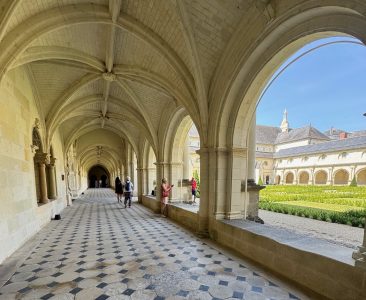
Eleanor is often celebrated for her political cunning and her influence on the arts — she was a passionate patron of the troubadours and courtly poetry. Eleanor outlived eight of her ten children, including her most famous son, Richard the Lionheart. She spent her final years at the Abbey of Fontevraud, where she died in 1204 at around 80 years old — a remarkable age for any era. Her effigy at Fontevraud Abbey is a wonderful last word: it larger and positioned higher than that of her husband Henry.
The effigy shows her wearing a crown and holding an open book — believed by some to be a Bible, by others to be a poetry collection. Either way, it speaks to a woman who valued knowledge and culture. That said, despite being Queen of England for decades, she never bothered to learn English.
Visit Eleanor’s World with French Wine Adventures or on a stay at Château Feely
On our wine tours and walking tours from Château Feely, you’ll discover the living history of Nouvelle-Aquitaine — the landscape, the wines, and the remarkable stories woven into it.
If you are staying at Chateau Feely and self guiding rather than booking a tour with us – just over an hour’s drive from Chateau Feely, you can visit Richard the Lionheart’s castle at Beynac in the Dordogne. We love pairing this with a stop at Château Milandes — the former home of another iconic woman of this region, the incomparable Josephine Baker.
Two queens of different centuries. One extraordinary corner of France.
🍷 Come and discover Aquitaine’s history — and wines — with us.Email us to book your tour.
Be the first to write a comment.
Your feedback

